High Viscosity Mixers
High viscosity mixers are industrial mixing machines that combine high torque at low speed with high-speed dispersion to process thick, non-flowing materials. Hockmeyer Equipment Corporation builds them for producers working with putty, sealants, adhesives, grease, and creams, where the batch will not circulate back into the space left by the blade and must be carried physically through the vessel instead. Hockmeyer's line combines low-speed helical and anchor-sweep agitation with high-speed dispersion in dual-shaft and triple-shaft options, available from laboratory units to 3,500 gallons. The equipment is robust and versatile, consistently generating a strong return on investment year after year.-
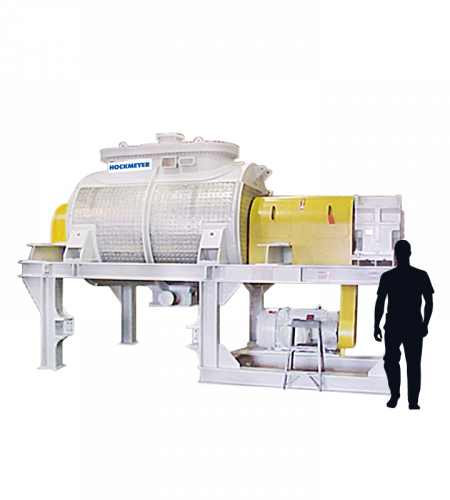
Horizontal Paste Mixer
Machine Features Available in standard sizes from 20 to 1,600 gallons, this horizontal paste mixer scales to meet a wide range of production requirements, from laboratory development to full industrial…
View Horizontal Paste Mixer
-
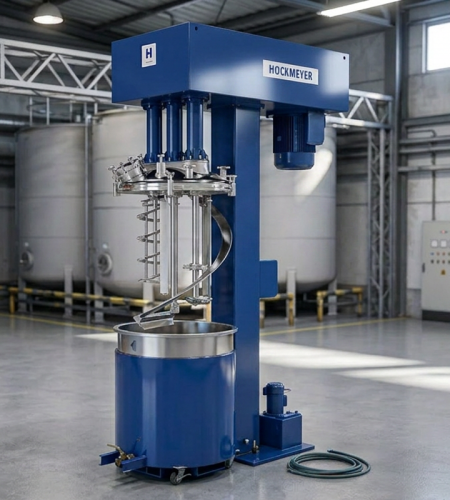
HHL-III Triple Shaft Mixer/Disperser
Features/Options Available Sizes from laboratory units to 3500 gallons Hoist or tank mounted configuration Inverter driven motors Stainless steel or carbon steel material of construction Helical and anchor sweep low-speed…
View HHL-III Triple Shaft Mixer/Disperser
-
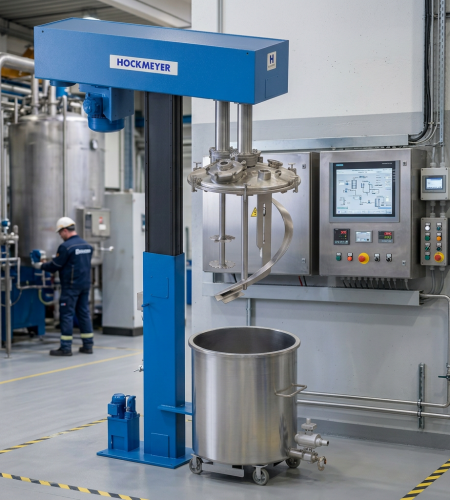
HHL-II Dual Shaft Mixer/Disperser
Features/Options Available Sizes from laboratory units to 3500 gallons Hoist or tank mounted configuration Inverter driven motors Stainless steel or carbon steel material of construction Helical or anchor sweep low-speed…
View HHL-II Dual Shaft Mixer/Disperser


High Viscosity Mixers FAQs
-
What is high-viscosity mixing?
High-viscosity mixing is the process of blending materials that resist flow and movement, making it more difficult to achieve uniformity than with low-viscosity products. The goal is still to create a homogeneous mixture, but it requires different mixing principles and equipment.
-
Why is mixing high-viscosity materials more challenging?
Highly viscous materials limit the formation of turbulence and eddy currents. Flow occurs mainly in streamlines, and movement decreases rapidly away from the mixing blade, making it harder to distribute energy and achieve uniform mixing. -
When does a formulation need a high-viscosity mixer instead of a standard disperser?
A formulation needs a high-viscosity mixer once it stops flowing back into the void created by the disperser blade. That behavior, rather than a specific viscosity number, is the practical threshold. A high-speed disperser works by drawing material into a vortex and shearing it as it circulates, so when the batch no longer returns on its own, the blade is only working the product immediately adjacent to it while the rest of the slurry in the vessel remains stationary. Restoring movement at that point requires a low-speed agitator that carries material through the vessel.
-
What is the difference between the HHL-II dual shaft and the HHL-III triple shaft mixer?
Both units combine low-speed and high-speed agitation on independently driven shafts, and both are available with helical or anchor sweep low-speed options. The dual shaft configuration pairs one low-speed agitator with one high-speed element. The triple shaft adds a third independently driven shaft, allowing a second high-speed element to operate in the batch simultaneously. Formulations that require simultaneous bulk movement and more than one mode of high-shear input are the typical case for the triple shaft.
-
Should the mixer be hoist-mounted or tank-mounted?
Hoist mounting raises the mixer assembly above the vessel, allowing a single machine to serve multiple tanks. That suits operations running several products or frequent changeovers, since one batch can be moved out for discharge or cleaning while the next tank is positioned.
Tank mounting fixes the mixer to a dedicated vessel, which simplifies the installation and is generally the better fit for continuous production of a single formulation. Both HHL-II and HHL-III units are available in either configuration.
-
When is a horizontal paste mixer the better choice than a vertical mixer?
Horizontal mixers move material along the axis of the vessel rather than around a vertical shaft, which works well for very stiff pastes and doughs that will not circulate under vertical agitation. They also discharge differently, since the geometry lends itself to emptying heavy material without relying on gravity flow.
-
Can equipment used for laboratory development be scaled to production?
Yes. Both the HHL-II and HHL-III are available in laboratory benchtop scale and production scale of up to 3,500 gallons within the same design elements, which make scale-up data meaningful. Developing a formulation for equipment that shares the agitator geometry and drive characteristics with the production machine reduces the risk that a process validated at a small scale will behave differently at volume.
-
Does construction material affect the process, or only cleaning and compliance?
Construction material affects all three. Stainless steel is required where the product cannot tolerate iron pickup or where sanitary cleaning standards apply, which covers most food, cosmetic, and pharmaceutical work. Carbon steel is a durable and more economical choice for products that are chemically compatible with it, such as many sealants, adhesives, and industrial pastes. Hockmeyer offers the HHL-II and HHL-III in either material.
Services
-
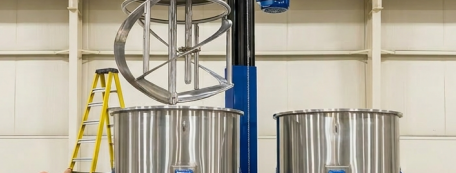
Stock Machines & Tanks NEW & USED
Our dedication to customer satisfaction doesn’t stop with the purchase.
-

Field Training & Support
Hockmeyer is dedicated to providing best-in-class support to maintain the lifespan and efficiency of your Hockmeyer equipment.
-
Equipment Support Program
Learn about how Hockmeyer can provide dedicated service, maintenance, and training through our Equipment Support Program.

